Can We Put a Giant Sunshade in Space to Cool Earth?
Posted 10 hours ago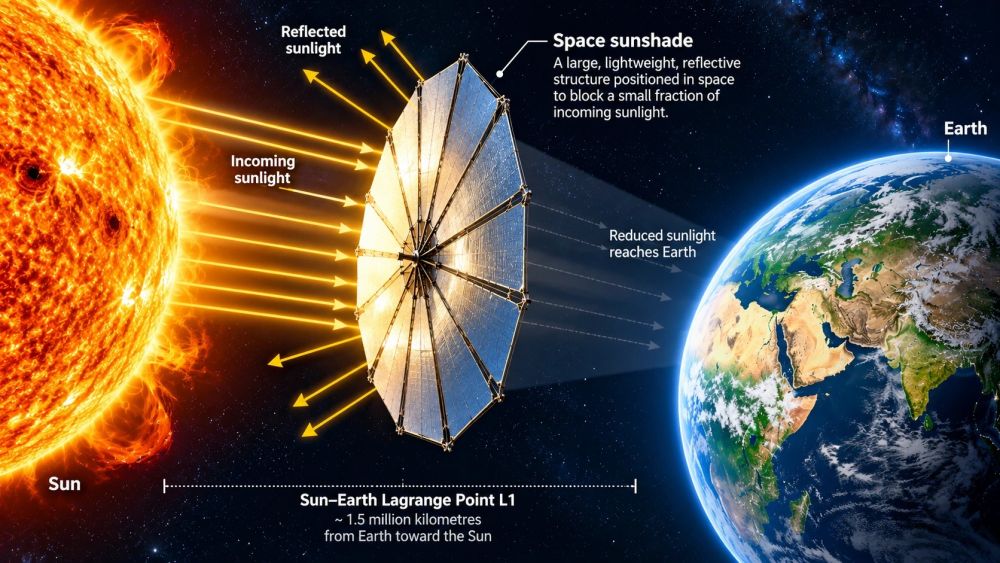
50/2026
Scientists are exploring an extraordinary idea to fight global warming: blocking a tiny fraction of sunlight before it reaches Earth. But could this technology work, and what risks might it pose? Elon Musk's social media post shares his view that launching satellites could cool Earth. The Planetary Sunshade Institute published a report supporting these ideas. According to Prof. Emeritus Dr. Muhammad Mukhtar, Rector of the University of Southern Punjab, Multan, Pakistan, and Editor-in-Chief of Greeningdotlive, the idea sounds like fiction. Still, every innovative scientific discovery starts as fiction.
Imagine placing a giant sunshade between Earth and the Sun to help cool a warming planet. It sounds like science fiction, yet scientists are seriously exploring whether advances in space technology could one day make this idea possible.
The reason is urgent. Human activities, particularly the burning of coal, oil, and natural gas, are increasing atmospheric concentrations of greenhouse gases. These gases trap heat, contributing to rising temperatures, melting glaciers, rising sea levels, and increasingly dangerous heat waves.
The primary solution remains clear: reduce greenhouse-gas emissions, transition to cleaner energy, and protect natural ecosystems. However, researchers are also examining whether technology could temporarily reduce some of the warming already underway.
One proposal is a giant sunshade in space, an ambitious concept that could alter how much solar energy reaches Earth.
How Would Space Sunshade Work?
Earth's climate depends partly on the balance between energy arriving from the Sun and heat escaping back into space. Greenhouse gases disturb this balance by trapping some of the outgoing heat.
A space sunshade would intervene at the other end of the process. By intercepting or redirecting a small fraction of incoming sunlight, it could reduce the energy Earth absorbs and potentially lower global temperatures.
Scientists classify this general approach as solar radiation modification, or solar geoengineering.
Could Falling Rocket Costs Make It Possible?
Recent advances in launch technology have sparked renewed interest. A Nature Journal report published in October 2026 discusses whether increasingly capable rockets and declining launch costs could make a space-based sunshade technically feasible in the coming decades.
However, lower launch costs do not automatically make the project affordable. Engineers would need to calculate the enormous amount of material required, the number of launches, the infrastructure needed for in-space assembly, and the long-term costs of maintenance and replacement. Another consideration is the environment: launching and manufacturing vast quantities of equipment would consume resources and could produce emissions and other environmental effects.
For now, a planetary sunshade remains a research concept, not established climate technology.
Would Cooling Earth Solve Climate Change?
Not entirely. This is the idea's most important limitation.
A sunshade could reduce temperatures, but it would not remove carbon dioxide from the atmosphere. It would not stop ocean acidification, restore damaged ecosystems, or eliminate the consequences of ongoing greenhouse-gas emissions. That is why emissions reduction remains essential. Renewable energy, energy efficiency, cleaner transportation, forest conservation, and reductions in methane emissions tackle the problem at its source.
Could One Country Cool the Planet Without Hurting Another?
Earth's climate is complex. A change that lowers global average temperatures could also alter rainfall, atmospheric circulation, and regional weather patterns.
This matters especially for countries that depend on seasonal rainfall. In South Asia, for example, the monsoon supports agriculture, drinking water supplies, and the livelihoods of millions. A lower global average temperature would not necessarily mean more reliable monsoon rainfall or fewer droughts in every region.
Researchers would need to investigate these possibilities using climate models, observations, and carefully designed scientific studies. Even then, uncertainties would remain.
Another concern is what happens if a sunshade stops operating while greenhouse-gas concentrations remain high. Its cooling effect would diminish, potentially allowing temperatures to rise rapidly. Any serious proposal would therefore require long-term maintenance, emergency planning and an honest assessment of the risks to future generations.
Who Would Control the World's Thermostat?
The political questions may be as difficult as engineering.
A space sunshade could affect every country, including those that did not finance or approve its deployment. One nation might favor more cooling, while another might fear rainfall changes that threaten its food supply.
Who would decide how much sunlight to block? Who would be responsible if a region were harmed? And how could poorer countries participate meaningfully in decisions that affect their climate and livelihoods?
These questions demand international cooperation, transparent scientific assessment, independent monitoring, and clear accountability mechanisms. A technology capable of influencing the shared climate cannot be treated as a private decision by a single government or corporation.
The Real Test of Climate Innovation
The prospect of a giant sunshade demonstrates how far human ingenuity may eventually reach. Yet technical possibilities are not the same as practical feasibility, environmental safety, or political acceptability.
Scientists should rigorously investigate unconventional ideas, but research into solar geoengineering must never become an excuse to delay emissions reductions. Nor should the promise of future technology distract from adapting communities to the climate change already underway.
A space sunshade might one day help scientists manage some aspects of global warming. Whether it could be deployed safely, affordably, and fairly remains uncertain.