Green Education: The Missing Link to a Sustainable Future
Posted 1 month ago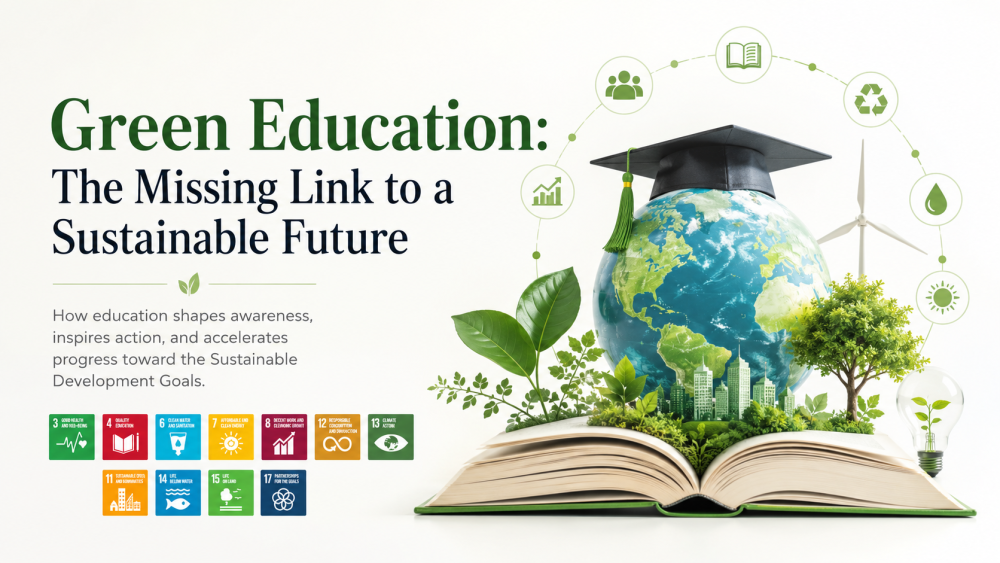
32/2026
Imagine a classroom where students don't just memorize the causes of climate change; they measure air quality in their neighborhoods, design rainwater harvesting systems, grow food in school gardens, calculate the carbon footprint of their campus, and develop solutions for a cleaner future.
This is green education.
As the world races against climate change, biodiversity loss, pollution, and resource depletion, scientists increasingly believe that technology alone cannot solve these interconnected crises. The missing ingredient is educated citizens who understand the environment and are willing to act responsibly. A recent comprehensive scientific review concludes that green education may be one of the most effective long-term strategies for achieving the United Nations Sustainable Development Goals (SDGs) by transforming knowledge into action and awareness into lasting behavioral change.
What Is Green Education?
Green education, also known as environmental education or education for sustainability, is an approach to learning that helps people understand how natural systems work, why environmental problems occur, and how individuals and communities can create sustainable solutions. Rather than treating environmental issues as a separate subject, green education integrates sustainability into every aspect of teaching and learning.
At its heart, green education seeks to develop:
• Environmental awareness
• Scientific understanding
• Critical thinking
• Responsible decision-making
• Sustainable lifestyles
• Community action
Its goal is not simply to produce graduates with degrees, but citizens capable of protecting both people and the planet.
Understanding Sustainable Development
The United Nations popularized the idea of sustainable development and is commonly defined as:
Meeting the needs of the present without compromising the ability of future generations to meet their own needs.
Sustainability rests on three interconnected pillars:
• Environmental sustainability - protecting ecosystems and natural resources.
• Economic sustainability - promoting prosperity without exhausting resources.
• Social sustainability - ensuring health, equality, inclusion, and well-being.
Green education brings these three pillars together, helping learners understand that economic growth, environmental protection, and social progress are not competing goals but complementary ones.
What Are the Sustainable Development Goals (SDGs)?
In 2015, all United Nations member states adopted the 17 Sustainable Development Goals (SDGs), a global blueprint to end poverty, protect the planet, and ensure prosperity for everyone by 2030.
These goals address issues ranging from quality education and clean water to climate action, clean energy, biodiversity conservation, and sustainable cities.
Experts believe that education is not merely one SDG (Goal 4: Quality Education); it is the engine that accelerates progress across nearly all seventeen goals.
Why Green Education Matters
Climate change is often portrayed as a technological challenge requiring renewable energy, electric vehicles, or carbon capture. Yet every technological solution depends on informed people willing to design, adopt, and support it.
Green education changes how people think.
Instead of viewing nature as an unlimited resource, learners begin to understand Earth's interconnected systems. They recognize how daily choices wasting food, conserving water, using public transport, recycling, or reducing energy consumption collectively shape the planet's future.
Learning Beyond the Classroom
One of green education's defining characteristics is nature-based learning.
Rather than limiting education to textbooks, students learn directly from forests, rivers, parks, wetlands, farms, and urban ecosystems. These real-world experiences help transform abstract scientific concepts into personal understanding.
Studies highlighted in the review show that students participating in nature-based learning often develop:
• Greater environmental responsibility
• Improved academic performance
• Stronger critical thinking
• Higher participation in conservation activities
• Better appreciation of biodiversity
Learning becomes an experience rather than a lecture.
Green Schools: Better for Students and the Planet
Green education also changes the places where students learn.
Green schools are designed to reduce environmental impact while improving student health and learning outcomes, such as incorporating natural lighting and rainwater harvesting, which demonstrate tangible benefits and motivate support.
According to the review, such schools can:
• Improve indoor air quality
• Reduce energy consumption by 20 - 40%
• Lower carbon emissions
• Reduce water use by about one-third
• Improve student attendance
• Enhance academic performance
• Reduce operational costs
In this way, school buildings themselves become living laboratories for sustainability.
Green Education Supports Multiple SDGs
Rather than contributing to a single development goal, green education advances many simultaneously.
According to an article Green Education is linked with several sustainable goals including:
• SDG 3: Better health through healthier schools and cleaner environments.
• SDG 4: Higher-quality, more inclusive education.
• SDG 6: Improved water conservation and sanitation awareness.
• SDG 7: Affordable and clean energy through energy efficiency and renewable energy literacy.
• SDG 8: Green jobs and sustainable economic growth.
• SDG 12: Responsible consumption and cleaner production.
• SDG 13: Climate action by reducing emissions and encouraging sustainable behavior.
Preparing Students for Green Careers
The green economy is creating entirely new professions.
Future graduates will increasingly work as renewable energy engineers, sustainable architects, environmental scientists, biodiversity specialists, circular economy designers, climate policy experts, green entrepreneurs, and environmental educators.
Green education equips learners with the interdisciplinary thinking required for these emerging careers while encouraging innovation and responsible entrepreneurship.
The Challenges Ahead
Despite its promise, green education is far from universally implemented. According to a review article challenges for green education are:
• Limited integration into teacher education programs
• Shortage of teaching resources
• Sustainability topics missing from curricula
• Limited teacher training
• Weak policy support
• Lack of a universally accepted understanding of sustainability
Without adequately trained educators and supportive educational systems, the transformative potential of green education remains constrained.
A New Definition of Education
For generations, education has largely focused on preparing people for employment.
Green education expands that mission.
It prepares people not only for careers but also for citizenship in an era defined by climate change, environmental uncertainty, and rapid technological transformation. It teaches learners how ecosystems function, how societies depend on natural resources, and how informed decisions today shape tomorrow's world.
By nurturing environmentally literate citizens who think critically, act responsibly, and innovate sustainably, green education has the potential to become one of the most powerful investments humanity can make for a healthier, more equitable, and more resilient future.