Ice Cave Bacteria Resistant to 10 Antibiotics Raise Climate Change Concerns
Posted 7 months ago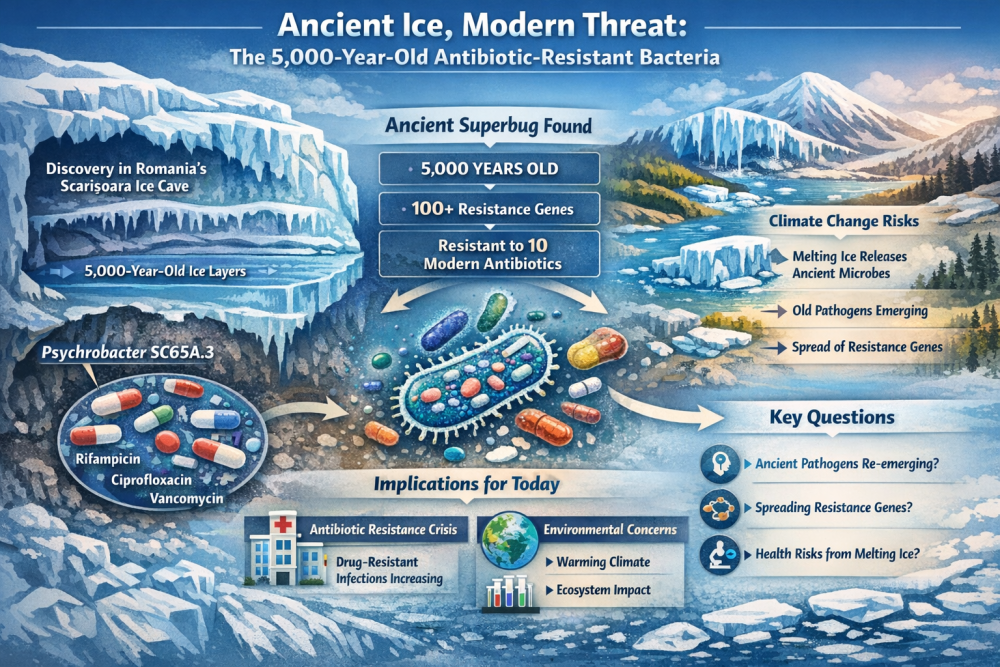
11/2026
Deep beneath the icy layers of the Scărișoara Ice Cave in Romania lies a remarkable discovery that underscores nature’s hidden history and its relevance to human health today. In a finding that challenges assumptions, researchers uncovered a 5,000-year-old strain of bacteria, named Psychrobacter SC65A.3, resistant to 10 modern antibiotics long before humans developed these drugs.
Several scientific outlets, including Phys.org and Discover Magazine, highlight how antibiotic resistance developed long before modern medicine, raising important questions about the future of global health amid climate change.
🧬 What Was Discovered? The Rise of a Frozen Survivor
Scientists drilled about 25 meters (82 feet) into the Scărișoara ice deposit, one of Europe’s oldest underground ice formations, to retrieve ice layers that date back thousands of years. Within these layers was Psychrobacter SC65A.3, a cold-loving bacterium that had survived for millennia in freezing conditions.
When researchers brought this ancient organism into the lab, they discovered that it:
- Resists 10 commonly used modern antibiotics across various drug classes, including key treatments like rifampicin, vancomycin, and ciprofloxacin for serious infections.
- Carries over 100 genes linked to antibiotic resistance, showing a complex genetic toolkit for resisting chemical threats.
- was never previously exposed to these drugs, proving that resistance can develop without human antibiotic use.
This challenges the common belief that antibiotic resistance is a recent development caused solely by clinical misuse and highlights the fact that nature has long influenced microbial defenses.
🌍 Why This Matters: The History and Current State of Antibiotic Resistance
Antibiotic resistance is already one of the top public health threats, making common infections more difficult, and sometimes impossible, to treat. The World Health Organization (WHO) estimates that millions of deaths occur worldwide each year because of drug-resistant infections, a problem made worse by the overuse of antibiotics in medicine and agriculture. Scientists now fear that ancient bacteria like SC65A.3 could serve as reservoirs for resistance genes that might re-enter modern microbial populations if released.
This is especially concerning as climate change accelerates the melting of icy environments worldwide, risking the release of ancient microbes into ecosystems, water systems, and human habitats. If SC65A.3 or its resistance genes spread, they could worsen antimicrobial resistance challenges, urging us to consider our role in environmental stewardship.
❄️ Environmental Dimensions: Ice as a Microbial Time Capsule
Ice caves like Scărișoara are not just geological formations; they are biological archives that capture snapshots of ancient ecosystems and life forms. These frozen vaults preserve DNA and microorganisms from eras long before recorded history, offering scientists a window into prehistoric biology.
However, global warming is intensifying these fragile systems. As glaciers and underground ice reservoirs melt, they risk releasing microbial life and genetic material that has been trapped for thousands of years. This raises complicated questions:
- Can ancient pathogens come back to life and interact with modern microbes?
- Could ancient resistance genes speed up antimicrobial resistance today?
- How should scientists weigh research benefits against biosafety risks?
These questions sit at the intersection of climate science, microbiology, and public health, highlighting that environmental changes affect not only rising sea levels and extreme weather but also microbial evolution and human disease risk.
🔬 A Double-Edged Sword: Threats and Opportunities
Despite the risks, Psychrobacter SC65A.3 also shows promise. Researchers observed that this ancient strain can inhibit some modern antibiotic-resistant pathogens and contains unique enzymes and genes that could lead to new classes of antibiotics or biotechnological tools.
This duality of ancient bacteria as both a threat and a resource highlights an important truth: nature’s innovations often surpass human understanding. By studying life that existed before modern civilization, we can discover clues about the origins of antibiotic resistance, which can lead to better strategies to fight it.
🧠 To Contemplate for a Better Future
The discovery of a 5,000-year-old antibiotic-resistant bacterium trapped in ice serves as a powerful reminder of how human health is closely connected to the environment. It highlights that:
- Antibiotic resistance is a natural evolutionary trait, not merely the result of excessive antibiotic use (a speculation).
- Climate change might expose ancient microbes with unknown effects, posing challenges to public health systems.
- Studying ancient organisms can provide insights that help develop future medical tools, while also managing their risks.
As we face climate change and increasing antimicrobial resistance, this discovery calls for urgent interdisciplinary research that combines microbiology, environmental science, and global health policy. The ancient bacteria trapped in ice might still hold lessons for humanity that we must listen to.