The World Is Learning to Go Green: Inside UNESCO’s Global Tracker for Greening Education
Posted 1 day ago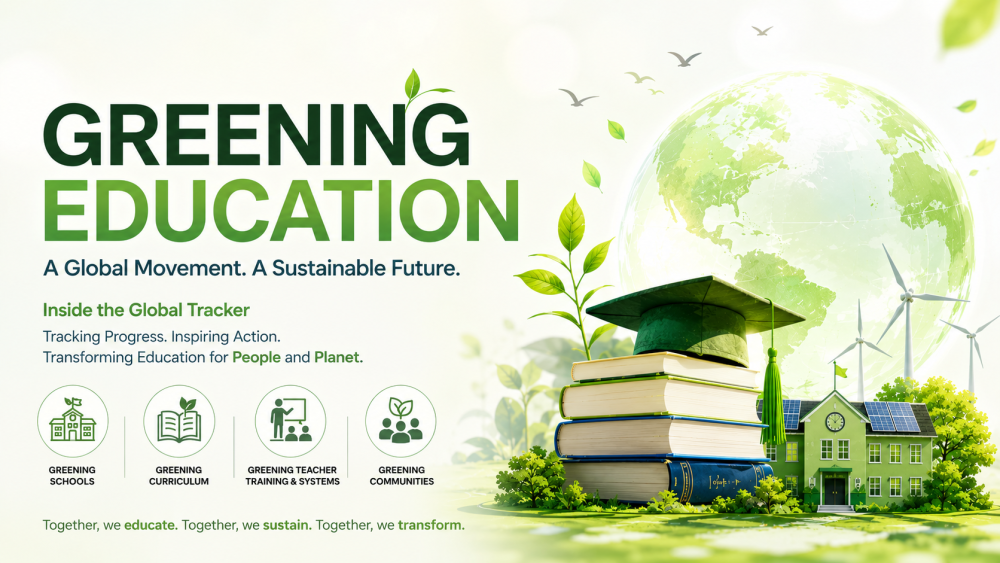
37/2026
Climate change is no longer a distant environmental challenge. It is reshaping economies, communities, workplaces, and, increasingly, the very future of education. As temperatures rise, ecosystems deteriorate, and extreme weather events grow more disruptive, one question has become impossible to ignore:
Are our education systems preparing learners for the world they will inherit?
A remarkable new global initiative is beginning to answer it.
The Greening Education Partnership (GEP) Global Tracker, developed by UNESCO in collaboration with ICESCO, has become a global mechanism for monitoring how countries are transforming their education systems to respond to climate change and advance sustainable development. Rather than treating environmental education as an isolated subject, the tracker advances a more ambitious idea: the entire education system must become green.
From teaching about climate change to transforming education
For decades, environmental education largely meant teaching students about pollution, biodiversity, climate change, and conservation. The new approach goes considerably further.
The Greening Education Partnership seeks to make education itself part of the solution.
Its framework is built around four interconnected pillars:
1. Greening Schools
Schools are expected to become sustainable, climate-resilient learning environments, not merely places where students hear about sustainability.
2. Greening Curriculum
Climate change, biodiversity, environmental sustainability, and related issues are to be integrated across national curricula and learning programs.
3. Greening Teacher Training and Education Systems
Teachers need the knowledge, skills, and confidence to prepare climate-ready learners, while education systems need the capacity to support them.
4. Greening Communities
Education must extend beyond school walls, supporting lifelong learning and enabling communities to become more resilient and sustainable.
This is what makes the initiative particularly significant. It does not define a green education system merely by solar panels, recycling bins, or tree planting. It connects infrastructure, curriculum, teachers, learners, and communities into a whole-system transformation.
A global dashboard for a global challenge
The GEP Tracker provides something long missing from the international climate conversation: a developing global picture of how education systems are responding.
The platform brings together an interactive global map, progress tracking, country snapshots and impact stories, allowing policymakers, educators, and other stakeholders to examine both quantitative progress and national experiences.
The scale is already substantial.
The tracker currently reports 99 countries as members of the Greening Education Partnership and more than 2,000 participating organizations. It also reports 115,528 green schools, and its curriculum indicator shows a 73% extent of inclusion of “green” content within National Curriculum Frameworks.
These numbers should not be interpreted simply as statistics. They represent the emergence of a global movement in which education is increasingly being recognized as a critical instrument of climate action.
The 2030 ambition
The Partnership has set particularly ambitious goals for the decade ahead.
Under its first pillar, the target is for 50% of schools in each country to be green by 2030.
Under the curriculum pillar, the target is for 90% of countries to green their national curriculum frameworks by 2030. GEP members are still developing targets for the teacher-training and community pillars.
These targets transform the conversation.
Instead of asking whether a country has a few environmentally conscious schools, policymakers can start asking:
How much of the education system is becoming climate-ready?
That is a far more consequential question.
Why the tracker matters
Global Tracker's importance goes beyond measurement.
What gets measured can be understood. What can be understood can be improved.
- For governments, the tracker can help identify gaps between policy commitments and their implementation.
- For education ministries, it can reveal where curriculum reform, teacher preparation, or school transformation requires greater investment.
- For universities and teacher-education institutions, it provides a framework for developing programs that address emerging climate and sustainability competencies.
- For educators, it reinforces the idea that climate education is not solely the responsibility of environmental science teachers. It is becoming a responsibility across disciplines.
- For young people, it offers something even more important: evidence that education is being repositioned as a central instrument for building a sustainable future.
Beyond the green school
One of the most powerful ideas behind the GEP is its understanding of a “green school” as a whole institution.
UNESCO's Green School Quality Standard is designed to harmonize approaches to school sustainability and promote a whole-institution model of Education for Sustainable Development. The goal is not simply to make buildings environmentally efficient but to connect learning, school management and the wider learning environment.
A genuinely green school therefore becomes a living laboratory.
- Students can learn about renewable energy by observing the school's energy system.
- They can study water conservation through the school's water-management practices.
- They can understand biodiversity through campus gardens.
- They can explore waste management through real-world institutional operations.
- They can learn about climate resilience not merely from a textbook, but from the environment in which they study.
In this model, the campus becomes the curriculum. The teacher is at the heart of the transformation. No education reform can succeed without teachers.
A climate-ready curriculum is only as effective as the educator who delivers it. That is why the GEP's third pillar, greening teacher training and education-system capacities, is so important.
Teachers increasingly need interdisciplinary capabilities that connect science with economics, technology, health, agriculture, social development, ethics, and citizenship.
The objective is not to turn every teacher into a climate scientist.
It is to enable every teacher to help learners understand how their discipline connects to a changing planet.
• A mathematics teacher can teach using energy and emissions data.
• A business teacher can explore the circular economy.
• An engineering teacher can introduce clean technologies.
• A health educator can examine climate-related health risks.
• A social sciences teacher can explore climate justice and migration.
• A technology teacher can develop solutions to improve resource efficiency.
Climate education therefore becomes everyone's education.
From knowledge to climate action
Perhaps the most important shift is from climate awareness to climate action. Knowing that the planet is warming is no longer enough. Young people need the capacity to analyze evidence, solve problems, innovate, collaborate, communicate, and act.
- • They need green skills for emerging industries.
- • They need entrepreneurial skills for sustainable businesses.
- • They need digital skills to monitor and manage environmental systems.
- • They need scientific literacy to distinguish evidence from misinformation.
- • They also need values that connect personal decisions to collective responsibility.
The ultimate objective is therefore not simply to produce students who know more about climate change.
Greening education can be much more than an environmental initiative. It can be a national strategy for skills development, innovation, employability, climate resilience, and sustainable economic growth.
The green transition will require technicians, engineers, entrepreneurs and skilled workers capable of installing renewable-energy systems, improving energy efficiency, managing water resources, developing sustainable agriculture, reducing waste, maintaining green buildings and supporting emerging clean technologies.
A new definition of educational excellence
For generations, educational excellence was primarily associated with examination results, research output, rankings, infrastructure and graduate employment.
Those measures remain important.
But the climate crisis is forcing us to ask a larger question:
Does an education system prepare its learners for the future or merely for the present?
The Global Tracker points toward a new definition of educational excellence in which a successful institution is not only academically strong, but also environmentally responsible, socially resilient and capable of preparing learners for a rapidly changing world.
The universities and schools that embrace this transformation early may ultimately become the institutions that define the next generation of education.
A living global experiment
The GEP Tracker is evolving. UNESCO describes it as a “living and evolving” platform because data, methodologies, and country information will continue to be updated and refined. Countries can update their snapshots, while organizations and individuals can contribute impact stories and examples of good practice.
That is an important feature, not a weakness.
Greening education is itself a journey.
- No country has completed it.
- No university has perfected it.
- No school can claim to have solved it.
- The world is learning together.
And the tracker gives that learning a global reference point.
The classroom of the future
The climate crisis has changed what society needs from education.
The classroom of the future cannot be disconnected from the world beyond its walls. It must prepare learners not only to pass examinations but also to navigate uncertainty, protect natural resources, build resilient communities, and create sustainable solutions.
That is why the Greening Education Partnership matters.
It marks a shift from education about sustainability to education for sustainability—and ultimately to education as an engine of climate action.
The numbers on the Global Tracker will keep changing.
- Countries will join.
- Schools will transform.
- Curricula will evolve.
- Teachers will acquire new capabilities.
- Communities will become learning environments.
But behind every number is a much larger possibility:
A generation of learners ready to help change for a sustainable future.