Aircrafts Traffice Engineering Against Global Warming: How Smarter Flight Paths Could Help Cool the Planet
Posted 1 day ago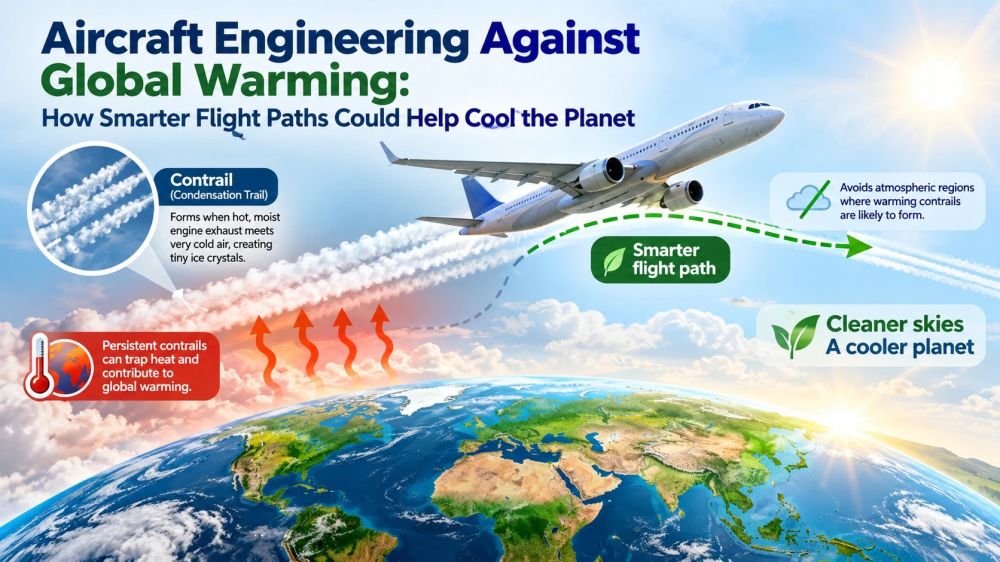
45/2026
Scientists are exploring how small changes to aircraft flight paths could reduce warming from persistent contrails, offering a practical climate solution while cleaner aviation technologies develop.
A contrail (condensation trail) is the white line sometimes seen behind an aircraft flying high in the sky. It forms when hot, moist engine exhaust meets very cold air, causing water vapor to freeze into tiny ice crystals. Some contrails disappear quickly, while others persist for hours and spread into thin clouds. These longer-lasting contrails can contribute to global warming by trapping heat that would otherwise escape from Earth’s surface.
What if a small adjustment to an aircraft’s route could help reduce this hidden climate impact without redesigning the plane, replacing its engine, or waiting for a new generation of aviation fuels?
Bill Gates highlights this intriguing possibility in his recent article, “For an Affordable Climate Win, Look to the Sky,” published on LinkedIn on October 12, 2026. His central argument is that avoiding certain aircraft condensation trails, commonly known as contrails, could yield meaningful climate benefits at a relatively low cost.
The idea deserves attention because the climate challenge is so large that the world needs more than one solution. Cleaner electricity, renewable energy, electric vehicles, and low-carbon fuels are all important. Yet there may also be opportunities to reduce warming by making better use of existing technologies and knowledge.
Sometimes, an important climate breakthrough may not require a revolutionary new machine. It may begin with a smarter decision about where a plane flies.
What exactly are contrails, and why do they matter?
Contrails are clouds of tiny ice crystals that form when hot, moist aircraft exhaust mixes with very cold air at high altitudes. Water vapor condenses around tiny particles in the exhaust, then freezes. Some contrails disappear within minutes. Others form in cold, humid atmospheric conditions and persist for hours, spreading into wispy clouds.
These persistent trails can influence Earth's energy balance. During the day, they may reflect some incoming sunlight into space. At the same time, they can absorb heat rising from Earth and slow its escape into space. The overall effect depends on the time of day, surrounding clouds, and atmospheric conditions, but persistent contrails are estimated to contribute to aviation-related warming. This is an important distinction: not every aircraft trail causes the same amount of warming, and not every contrail should be avoided automatically. The goal is to identify the flight paths and atmospheric conditions most likely to produce warming contrails.
A climate solution hiding in ordinary flight planning
Gates's proposal is remarkably straightforward. Aircraft already adjust altitude and direction to avoid storms, turbulence, and other hazards. Similar flight-planning techniques could help them avoid narrow atmospheric regions where persistent warming contrails are likely to form.
Weather forecasts, satellite observations, atmospheric models, and artificial intelligence can help identify these regions. Airlines could then make small adjustments to selected flights, perhaps climbing or descending slightly to pass above or below a contrail-forming layer. The key word is selected. No need to reroute every aircraft. Gates suggests that avoiding many warming contrail regions might be possible by adjusting the routes of about five percent of flights globally. This is his estimate, not a universally established operational result.
There is already experimental evidence that the concept can work. A 2024 study in Communications Engineering tested contrail avoidance on commercial flights by using predicted contrail-forming regions and altitude adjustments. Satellite observations showed a 64 percent reduction in visible contrails on the adjusted flights, though those flights used about two percent more fuel per flight. This is encouraging, but it also highlights the central challenge: avoiding contrails must reduce the overall climate impact, not simply exchange one form of warming for another.
Could a small change make a big difference?
Gates argues that contrail avoidance could be a relatively inexpensive climate intervention. In his article, he estimates the cost to be below $10 per ton of emissions-equivalent warming avoided, potentially around $1–$2, compared with $130 or more per ton for sustainable aviation fuel. These figures are estimates presented in his article, not guaranteed costs for every airline or route. Actual results will depend on weather forecasts, flight operations, fuel consumption, technology, and how the climate benefits are calculated.
Why does this matter? Because the world cannot afford to wait for a single perfect solution.
Developing sustainable aviation fuel, electric aircraft, and other low-carbon technologies remains essential. However, these innovations require investment, infrastructure, and time. Contrail avoidance could complement them by reducing another component of aviation's climate impact, using existing aircraft and improved planning software. In other words, we should pursue long-term technological breakthroughs while implementing scientifically sound measures that can deliver benefits sooner.
Science is promising, but accuracy matters.
Evidence, not attractive headlines, must guide a responsible climate solution.
Scientists still face uncertainties about exactly where persistent contrails will form, how long they will last, and how much warming they will produce. Research published in Nature Communications in 2025 showed that contrails forming within existing cirrus clouds can have more complex effects than previously assumed.
Fuel use is another important consideration. A detour that prevents a warming contrail may help, but a poorly chosen detour could burn extra fuel without providing sufficient climate benefits. For that reason, airlines need reliable forecasts, validated models, satellite monitoring, and transparent reporting. The most successful systems will identify high-impact opportunities rather than treat every white trail in the sky as a problem.
Gates also highlights collaborative efforts involving Contrails.org, American Airlines, and Google Research, including flight trials and additional research into contrail avoidance. These partnerships demonstrate how scientists, software developers, airlines, and air traffic authorities can work together on a problem that no single organization can solve alone.
A practical lesson for the climate debate
The most important message from this story is not that contrails alone will solve climate change. They will not. Nor should contrail avoidance distract governments from reducing carbon dioxide emissions, protecting ecosystems, or accelerating the transition to cleaner energy. The real lesson is that climate action works better when we look beyond the most obvious sources of pollution.
Aviation's environmental footprint extends beyond the fuel aircraft burn. The atmosphere itself responds to what happens thousands of meters above the ground. By understanding those processes more accurately, researchers may identify opportunities to reduce warming without waiting for entirely new aircraft or engines.
Bill Gates's article highlights one such opportunity: using better science, improved forecasting, and smarter flight planning to avoid some of the contrails that contribute to global warming.
Prof. Emeritus Dr. Muhammad Mukhtar, Rector of the University of Southern Punjab (USP) in Multan, Pakistan, who also manages the greening. live website promoting awareness of climate issues, praises this novel idea and underscores the importance of innovative, science-based approaches to combating climate change and global warming. Exploring practical solutions, such as engineering smarter aircraft flight paths to reduce the warming effects of persistent contrails, shows how scientific knowledge and technological innovation can open new pathways for climate action.
Mukhtar concludes: Let us challenge conventional thinking, invest in intelligent engineering, and turn scientific breakthroughs into climate solutions, because protecting our planet requires not only bold ideas but also decisive action today.