The Air Inside Our Homes: How Buildings Are Quietly Impacting Our Health
Posted 5 months ago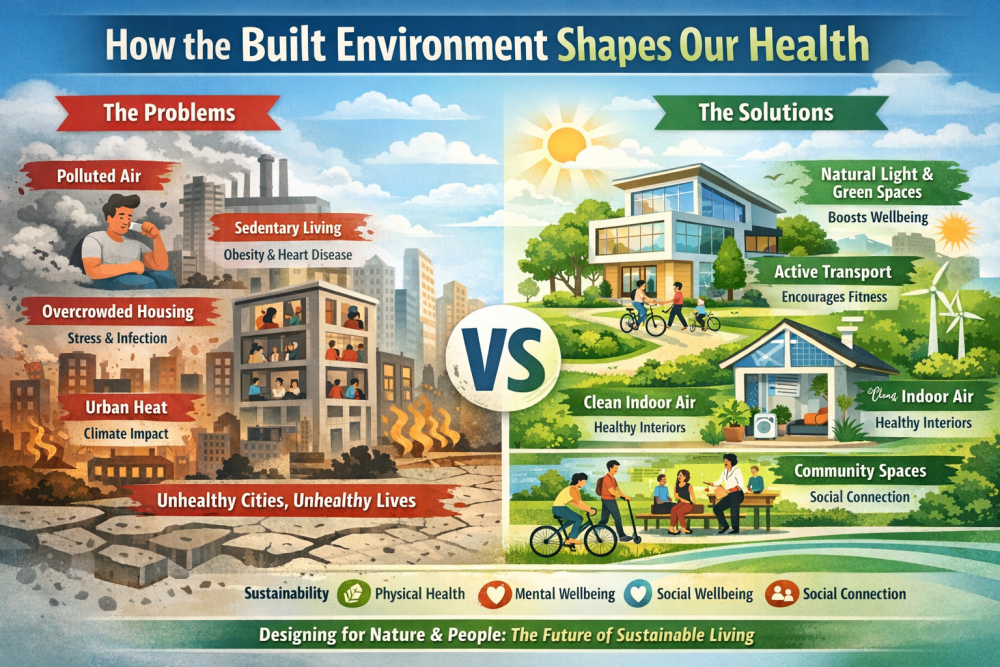
15/2026
We often think of health as something personal: what we eat, how we exercise, and whether we sleep. But long before personal choices come into play, something more basic is already shaping our wellbeing: the walls around us, the streets we walk on, the air trapped between concrete and glass.
This is the built environment, the human-made world of buildings, roads, neighborhoods, and cities. It is, quite literally, the stage on which human life unfolds. And as a growing body of research shows, it is also a powerful, often invisible factor that influences health.
A silent architect of health
The influence begins quietly.
A poorly ventilated room can harbor pollutants that worsen asthma. A neighborhood lacking sidewalks discourages walking, pushing residents toward sedentary lifestyles. Overcrowded housing can affect mental health, increase stress, and even accelerate the spread of infectious diseases, as the COVID-19 pandemic revealed.
In fact, the built environment influences not only how we live but also how long and how well we live. It affects access to clean air, safe water, green space, mobility, and social connection, all vital components of health.
And yet, for decades, we have built cities as if health were an afterthought.
When buildings fight nature
Modern construction has often been an act of defiance against nature, sealing buildings tight, flattening landscapes, and replacing ecosystems with asphalt. But this approach is increasingly being questioned.
A recent perspective in the Nature journal argues that the future is not about resisting nature, but about learning from it. Buildings and cities, it suggests, should function more like living systems, adaptive, efficient, and interconnected.
Think of a forest: nothing is wasted, everything is reused, and each part contributes to the health of the whole. Now compare that to a typical city, where energy is used up, waste is exported, and heat is trapped.
The contrast is stark — and increasingly unsustainable.
The cost of getting it wrong
When the built environment fails, the consequences ripple outward:
- Physical health declines through pollution, heat stress, and inactivity
- Mental health suffers in grey, isolated, or overcrowded spaces
- Inequality deepens, as poorer communities often face the worst conditions
- Climate change accelerates, with buildings responsible for a significant share of global emissions
In other words, unhealthy buildings create unhealthy societies.
Designing for life, not just living
So, what would a healthier built environment look like?
The solution is a straightforward but impactful change: planning buildings and cities as ecosystems, not machines.
1. Let nature back in
Natural light, fresh air, and greenery are not luxuries. They are biological necessities. Integrating plants, open spaces, and water systems into urban design improves both physical and mental well-being.
2. Build for movement
Walkable streets, cycling lanes, and accessible public transport encourage daily physical activity, reducing chronic diseases and improving quality of life.
3. Clean air indoors
People spend most of their lives indoors. Ventilation, non-toxic materials, and air filtration should be regarded as public health essentials, not optional enhancements.
4. Use resources wisely
Sustainable buildings decrease energy and water consumption, lower emissions, and minimize waste — safeguarding both environmental and human health.
5. Design for community
Spaces that encourage interaction, such as parks, shared courtyards, and public squares, strengthen social ties, which are as vital to health as medicine.
6. Learn from nature
Biomimicry, the design of buildings inspired by natural systems, offers a blueprint for resilience, efficiency, and environmental harmony.
A public health revolution in disguise
The idea that architecture can act as a form of medicine isn't new. In the 19th century, cities were redesigned to combat infectious diseases. Today, we face different challenges: chronic illness, mental health issues, and climate change, but the main concept remains the same.
If we want healthier populations, we need to create healthier environments.
Because the truth is both simple and profound:
We design our buildings, and then our buildings influence us.
The future we can still build
There is cautious optimism.
Around the world, a quiet transformation is underway: green buildings, sponge cities that absorb floodwater, energy-efficient homes, and urban forests reclaiming space from concrete. These are not just environmental solutions; they are health interventions.
A sustainable built environment, as global experts emphasize, is not only about reducing carbon but also about creating places where people can truly thrive.
The challenge now is scale.
Will we continue to construct cities that exhaust both planet and people?
Or will we design spaces that heal, restore, and sustain life?
The answer will be written not in policy papers, but in bricks, streets, windows, and the air we breathe between them.