Clean and Green Energy Resources: Energy, Environment, and Sustainable Human Development -Lecture 11
Posted 7 months ago
7/2026
Energy forms the backbone of modern civilization and plays a vital role in shaping social, economic, and environmental outcomes. From basic needs like cooking and heating to complex systems for industry, transportation, healthcare, and digital communication, every part of human life depends on energy. As populations grow and living standards rise, global energy demand continues to increase. This growing demand has placed energy issues at the forefront of environmental science, as the way energy is produced and used directly affects environmental quality, climate stability, and human health. In Pakistan, initiatives like the China-Pakistan Economic Corridor (CPEC) and the development of solar parks demonstrate local efforts to address these challenges, making the global energy discussion more tangible for Pakistani readers.
Understanding different energy sources and their environmental impacts is essential for addressing today's environmental challenges and empowering individuals and communities to make responsible energy choices that promote sustainability.
Globally, energy sources are mainly divided into renewable and non-renewable types. Renewable energy sources are those that naturally regenerate and are constantly available through Earth’s natural processes. These sources are considered clean and environmentally friendly because they do not deplete finite natural reserves and generally produce less pollution. Solar energy, which originates from sunlight, can be captured using photovoltaic panels and solar thermal systems to generate electricity and heat. Wind energy converts the kinetic energy of moving air into electrical power with wind turbines. Hydropower relies on the movement of water in rivers and through dams to generate electricity, while biomass energy comes from organic materials such as wood, crop residues, and agricultural waste. Geothermal energy taps into the heat stored inside the Earth’s interior and provides a reliable source of clean energy in suitable areas.
Renewable energy sources are vital to clean, green energy transitions because they enhance energy security while minimizing environmental harm. Unlike traditional fuels, renewable sources do not run out within a human lifespan and play a crucial role in reducing greenhouse gas emissions. Their adoption is therefore closely linked to the Sustainable Development Goals, climate change mitigation, and environmental protection. Despite challenges such as intermittency, infrastructure requirements, and initial costs, renewable energy remains one of the most practical solutions to worldwide energy and environmental crises. In Pakistan, projects like the Quaid-e-Azam Solar Park and wind farms in Sindh exemplify how these challenges are being addressed through innovative solutions and government support.
In contrast, non-renewable energy sources are finite and cannot be replenished within a human lifetime. These sources include fossil fuels such as coal, oil, and natural gas, as well as nuclear fuels. Fossil fuels formed over millions of years from the buried remains of ancient plants, animals, and microorganisms subjected to intense heat and pressure. Because of their high energy density and reliability, fossil fuels have historically dominated global energy systems, powering industrial growth and economic development.
However, the environmental impacts of fossil fuel use are substantial. The extraction, processing, and burning of fossil fuels emit large amounts of pollutants into the environment. Carbon dioxide emissions from burning coal, oil, and natural gas are the main drivers of global climate change. In addition to carbon dioxide, fossil fuel combustion releases sulfur dioxide, nitrogen oxides, and particulate matter, which contribute to air pollution, acid rain, and serious public health problems. Furthermore, fossil fuel reserves are limited, raising significant concerns about long-term energy security and sustainability.
One of the key links between energy consumption and environmental harm is the release of carbon dioxide. Carbon dioxide is released whenever fossil fuels are burned for electricity, transportation, industrial activities, or household energy needs. Vehicles powered by gasoline and diesel emit carbon dioxide directly into the atmosphere, while electricity generated from coal, oil, and gas contributes to emissions indirectly through power plants. As global energy use increases, atmospheric carbon dioxide levels continue to rise, intensifying the greenhouse effect.
Greenhouse gases are atmospheric gases that trap heat and prevent it from escaping into space. Although the greenhouse effect is a natural process necessary for maintaining Earth’s temperature, excessive greenhouse gas emissions disrupt the planet’s energy balance. Key greenhouse gases include carbon dioxide, methane, nitrous oxide, ozone, water vapor, hydrofluorocarbons, and sulfur hexafluoride. Among these, carbon dioxide is the most significant because of its abundance and long atmospheric lifetime. The accumulation of greenhouse gases leads to global warming, which causes climate change resulting in rising temperatures, melting glaciers, sea-level rise, altered rainfall patterns, and more frequent extreme weather events.
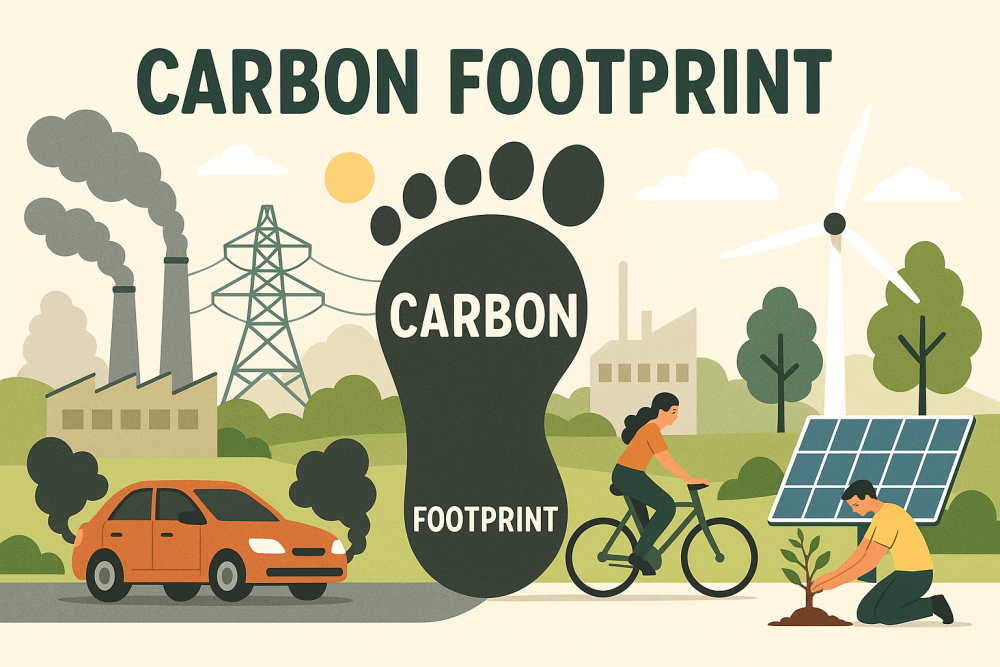
To evaluate and manage the environmental impact of human actions, the concept of the carbon footprint has become increasingly significant. A carbon footprint is the total amount of greenhouse gases, primarily carbon dioxide, emitted by human activities. It can be calculated for individuals, households, organizations, products, services, or entire countries. Carbon footprints result from daily activities such as electricity consumption, transportation, industrial processes, farming methods, food intake, and waste generation.
Carbon footprints are measured in carbon dioxide equivalents, which combine different greenhouse gases into a single comparable unit. This measurement offers a clear indicator of climate impact and helps identify areas where emissions can be reduced. On average, a person emits between one and fifteen tons of carbon dioxide equivalent annually, with the global average estimated at four to five tons. This level greatly exceeds what the Earth can sustainably absorb without causing dangerous climate change.
Lifestyle choices greatly impact the size of your carbon footprint. High-consumption lifestyles that involve frequent use of private vehicles, air travel, meat-heavy diets, and extensive energy consumption contribute to larger carbon footprints. In contrast, low-consumption lifestyles that prioritize public transportation, plant-based diets, energy-efficient appliances, and renewable energy sources lead to significantly lower emissions. To meet international climate goals, scientists recommend reducing average per-person emissions to about 2 tons of carbon dioxide equivalent by 2030 and to roughly 1 ton by 2050. Individuals in Pakistan can contribute by adopting solar-powered appliances, using public transport, and supporting local renewable energy projects, making the global effort more inclusive and actionable.
A key strategy to reduce emissions worldwide is the use of carbon credits. Carbon credits represent the removal, reduction, or avoidance of one metric ton of carbon dioxide or its equivalent greenhouse gases from the atmosphere. They serve as the basis for carbon-trading systems, which encourage governments and industries to invest in renewable energy, reforestation, and energy-efficiency projects. By assigning economic value to emission reductions, carbon credits foster the adoption of cleaner technologies and sustainable practices.
The need for clean and green energy is especially critical in Pakistan. The country faces ongoing energy shortages, heavy reliance on imported fossil fuels, rising electricity costs, and persistent circular debt. These economic problems are linked to serious environmental issues, particularly air pollution in major cities such as Lahore, Karachi, and Multan. Poor air quality has become a major public health concern, causing higher rates of respiratory and cardiovascular diseases.
Recognizing these challenges, Pakistan has taken several steps to promote renewable energy and reduce its carbon footprint. Solar energy projects have expanded through utility-scale solar parks, rooftop net metering for homes, businesses, and schools, and the solarization of government buildings. Biomass and bagasse-based energy production, particularly from sugar mills using agricultural waste, has supplied electricity to the national grid. Additionally, Pakistan has begun encouraging electric mobility by building charging stations, offering incentives for local electric vehicle manufacturing, and setting targets for broader adoption of electric vehicles.
In conclusion, clean and green energy resources are essential for achieving environmental sustainability, energy security, and climate resilience. The shift from fossil fuels to renewable energy is more than just an environmental decision; it is a societal necessity. By adopting sustainable energy practices, lowering carbon footprints, and supporting clean technologies, societies can combat climate change and preserve natural ecosystems. Environmental science provides the theoretical and practical framework to guide this shift and secure a sustainable future for current and future generations.
Question 1
Explain the role of energy in human life and discuss why energy is a central concern of environmental science.
Energy is crucial for supporting human life and modern civilization. All vital human activities, such as food production, transportation, manufacturing, healthcare, and communication, depend on a consistent energy supply. As societies expand and populations grow, energy demand increases, putting more pressure on natural resources. Environmental science considers energy a key issue because how it is produced and used directly affects air quality, climate stability, ecosystem health, and human well-being. Unsustainable energy consumption leads to pollution, climate change, and resource depletion, making energy management a vital environmental challenge.
Question 2
Describe renewable energy sources and explain why they are considered sustainable.
Answer:
Renewable energy sources are natural processes that continually replenish themselves, such as sunlight, wind, flowing water, organic matter, and geothermal heat. These sources are considered sustainable because they won't run out within a human lifetime and generally have lower environmental impacts than fossil fuels. Renewable energy produces minimal greenhouse gas emissions during operation and helps reduce reliance on finite resources. By using renewable energy, societies can meet current energy needs while protecting environmental quality and resource availability for future generations.
Question 3
Discuss non-renewable energy sources and explain their environmental consequences.
Answer:
Non-renewable energy sources include fossil fuels such as coal, oil, and natural gas, as well as nuclear fuels. These resources are finite and formed over millions of years, making them impossible to replace within a human lifetime. Although they provide reliable, high-energy output, their use has serious environmental impacts. Burning fossil fuels releases carbon dioxide and other pollutants that contribute to air pollution, climate change, acid rain, and health issues. Resource extraction also harms ecosystems and landscapes, exacerbating environmental degradation.
Question 4
Explain how fossil fuels contribute to climate change.
Answer:
Fossil fuels mainly contribute to climate change by releasing carbon dioxide during burning. When coal, oil, or natural gas is burned for electricity, transportation, or industrial activities, large amounts of carbon dioxide are released into the atmosphere. This greenhouse gas traps heat, strengthening the greenhouse effect. Over time, the buildup of carbon dioxide causes global warming, which drives climate change and its related effects, such as rising temperatures, changing weather patterns, and sea-level rise.
Question 5
What are greenhouse gases, and why are they important in understanding global warming?
Answer:
Greenhouse gases are gases in the atmosphere that trap heat and prevent it from escaping into space. Important greenhouse gases include carbon dioxide, methane, nitrous oxide, ozone, and water vapor. While these gases naturally regulate Earth’s temperature, excessive emissions from human activities increase the greenhouse effect, leading to global warming. Understanding greenhouse gases is crucial because they are the main drivers of climate change, influencing how much the temperature rises and how the environment is affected.
Question 6
Define carbon footprint and explain its relevance in environmental management.
Answer:
A carbon footprint is the total amount of greenhouse gases emitted by human activities, measured in carbon dioxide equivalents. It is important in environmental management because it measures the climate impact of individuals, organizations, products, and processes. By calculating carbon footprints, decision-makers can identify major sources of emissions and develop strategies to reduce them through energy efficiency, renewable energy, and sustainable lifestyle choices.
Question 7
Discuss the concept of sustainable carbon footprint levels for individuals.
Answer:
Sustainable carbon footprint levels refer to emission limits that the Earth can absorb without triggering severe climate change. Scientists estimate that to meet global climate goals, average per-person emissions should be reduced to about 2 tons of carbon dioxide equivalent by 2030 and to 1 ton by 2050. Achieving these targets requires major changes in energy use, transportation habits, dietary choices, and consumption patterns, with a focus on efficiency and renewable energy.
Question 8
Explain carbon credits and their role in reducing greenhouse gas emissions.
Answer:
Carbon credits represent one metric ton of carbon dioxide or its equivalent that has been reduced, avoided, or removed from the atmosphere. They help lower greenhouse gas emissions by offering financial incentives for emission-reduction projects. Through carbon markets, organizations can invest in clean energy, reforestation, and efficiency projects, supporting global efforts to address climate change.
Question 9
Analyze the energy and environmental challenges faced by Pakistan.
Answer:
Pakistan faces multiple energy and environmental challenges, including chronic energy shortages, heavy reliance on imported fossil fuels, high electricity costs, and increasing circular debt. These issues are worsened by severe air pollution in major urban centers, creating serious health risks. Solving these problems requires shifting to renewable energy, boosting energy efficiency, and creating sustainable policy frameworks.
Question 10
Describe Pakistan’s initiatives toward clean and green energy and their significance.
Answer:
Pakistan has launched several initiatives to promote clean and renewable energy, such as large-scale solar parks, rooftop solar panels, biomass-based power generation, and electric mobility programs. These efforts are important because they decrease reliance on imported fuels, reduce greenhouse gas emissions, improve air quality, and support long-term energy security and sustainable growth.