COP31: A Gathering of Hope in a Warming World – Why the Climate Conversation Must Never Stop
Posted 22 hours ago
1 Likes, 45 views
52/2026
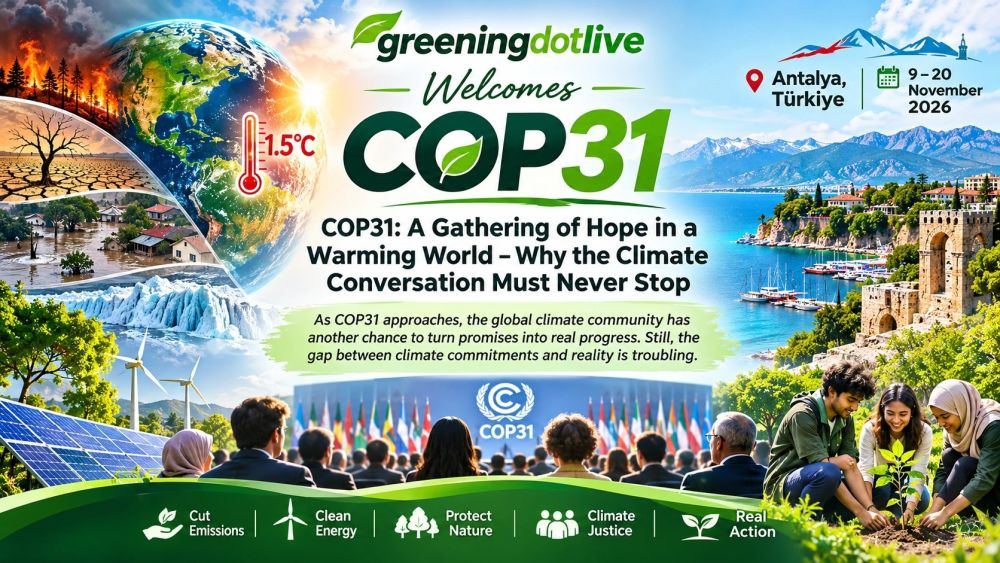
As COP31 begins, the global climate community has another chance to turn promises into real progress. Still, the gap between climate commitments and reality is worrisome.
Every year, we see more consequences of climate change: floods, droughts, heatwaves, melting glaciers, forest fires, and unpredictable weather. These are not distant warnings anymore. They affect our health, food, jobs, and future generations.
With all this happening, the world is getting ready for another important meeting: the 31st Conference of the Parties, or COP31. This event matters because people everywhere are still working to solve climate problems.
What Exactly Is COP?
COP stands for Conference of the Parties. It is the annual meeting of countries that are members of the United Nations Framework Convention on Climate Change (UNFCCC), an international agreement established in 1992 to address the threat of climate change.
The first COP took place in Berlin in 1995. Since then, representatives of governments, scientists, international organizations, businesses, civil society and young people have gathered to discuss how to limit global warming and respond to its consequences.
These meetings are more than just international conferences. They give countries a place to negotiate how to cut greenhouse gas emissions, switch to cleaner energy, protect forests, fund climate action, and help vulnerable communities adapt.
A major achievement was the 2015 Paris Agreement, where countries agreed to limit global warming to 1.5°C above pre-industrial levels and keep it well below 2°C. This was a historic promise, but meeting it has been very hard.
COP31: A Moment of Truth for the Planet
COP31 will take place in Antalya, Türkiye, from 9 to 20 November 2026, at a crucial time for climate talks. Türkiye is hosting, and Australia is leading the negotiations. The world is close to passing the 1.5°C warming limit set by the Paris Agreement.
A report in the world-class journal Nature, published on 9 November 2026, highlights the urgency. Scientists warn that we are close to exceeding the 1.5°C target and say governments need to quickly cut carbon emissions and remove carbon dioxide already in the air.
This raises a tough question: after 30 international climate conferences, why are we still struggling to meet the goals we all agreed on?
The answer is complicated, but part of it is the gap between promises and action. Countries still argue about who should pay, how fast to move away from fossil fuels, and how to share climate costs. Developing countries, which often cause less pollution but suffer more from climate change, are asking richer nations for financial help, technology, and real commitments.
The world has made progress, but not fast enough. Promises to cut emissions have not led to big enough changes. Financial help has not reached vulnerable communities as much as needed, and the shift to clean energy is still uneven.
But giving up would also be wrong, because real progress has been made, even if it is not enough yet.
Reasons to Remain Optimistic
There are real reasons to be hopeful. Renewable energy, especially solar and wind, is growing fast. Electric cars are more common, battery technology is improving, and innovations are opening up opportunities we could not imagine before.
Climate action is no longer just about government talks. Universities, researchers, businesses, local governments, and young people are all becoming part of the solution.
Climate change is more than just an environmental problem. It is a public health emergency, an economic challenge, a food security issue, and a matter of social justice. Extreme heat, air pollution, disease, and disasters show that climate action is an investment in our survival and well-being.
COP31 should be more than just another diplomatic meeting. It needs to be a place for real action, accountability, and measurable progress. The world needs less talk and more results.
Why COP31 Deserves Our Welcome
Prof. Emeritus Dr. Muhammad Mukhtar, Rector of the University of Southern Punjab, Multan, Pakistan, says that seeing almost every nation come together to discuss a problem that affects everyone is truly encouraging. Political differences, economic gaps, and national interests may divide us, but the air, oceans, and climate belong to all people. The real achievement of COP is not just the agreements made, but countries' ongoing willingness to talk, negotiate, and accept their shared responsibility for the planet.
These conferences will be judged by what happens after the delegates go home. Every promise should lead to real changes in national policies, institutions, cleaner technology, protected ecosystems, and better lives for people.
Prof. Mukhtar also says that schools and universities have a duty to help by doing research, encouraging innovation, raising public awareness, and preparing students to face environmental challenges.
A Message of Hope, With a Sense of Urgency
Greeningdotlive, led by Prof. Mukhtar, welcomes COP31 with cautious optimism. We support the gathering of nations, the scientific talks, the new commitments, and the shared determination to protect our planet.
But being hopeful should not lead to complacency. Missing the 1.5°C goal should wake us up, not make us give up. Even if we go over the limit for a while, every bit of warming we avoid matters. Every ton of carbon we prevent, every forest we save, every ecosystem we restore, and every community we strengthen makes a difference.
The climate crisis will not wait for another conference, another statement, or another political cycle.
COP31 should remind us that we have only one planet, one connected climate system, and a shared duty to future generations.
Let Antalya be remembered not just as the city that hosted another climate conference, but as the place where the world decided to turn promises into action. Let it be a turning point for real results.
The planet does not need more ambitious speeches. It needs courage, scientific leadership, political commitment, and steady action. xx