Europe's New Climate Reality: When Extreme Heat Becomes the Norm
Posted 2 months ago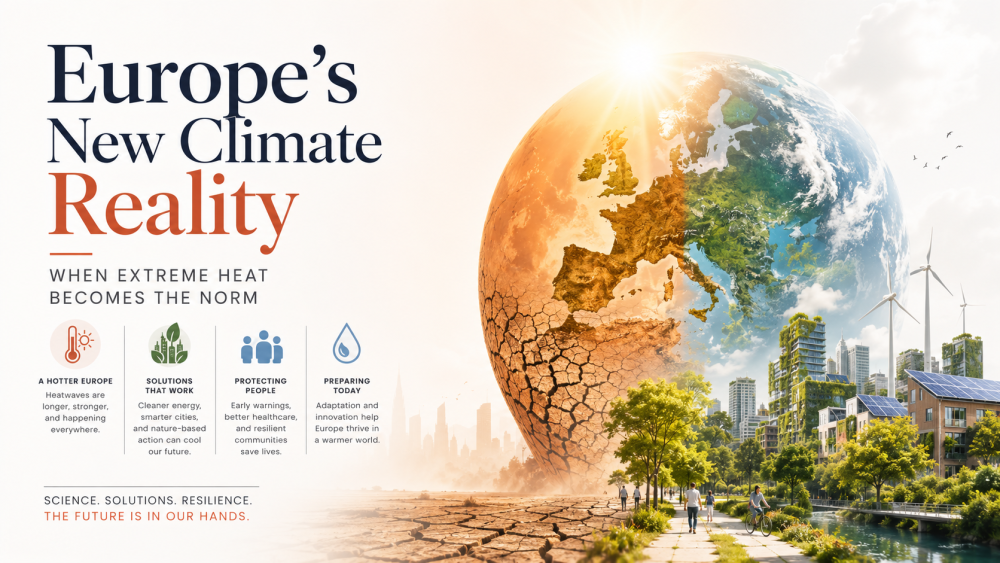
29/2026
An article in the journal Nature argues, "Europe’s record heatwave: does the continent have a new climate?" In the following greening.live presents its analysis based on this article.
For generations, Europeans viewed extreme heat as a rare event, something that happened once in a lifetime and was soon forgotten. But the summer of 2026 has changed that perception forever. Scientists now believe Europe is not experiencing just another heatwave; it is witnessing a fundamental shift in its climate. What was once considered exceptional is rapidly becoming the new normal, signaling that Europe's summers are entering a hotter era.
The latest attribution analyses indicate that human-driven greenhouse gas emissions have fundamentally altered the likelihood and intensity of extreme heat across the continent. Temperatures once considered extraordinary are increasingly routine, while records continue to fall with unsettling regularity. The question is no longer whether climate change is influencing European weather. The evidence shows that it is redefining what Europeans should consider "normal."
Heat dries vegetation and soil. Dry landscapes absorb and radiate more heat. Wildfires become more frequent, degrading air quality and releasing additional carbon into the atmosphere. Rivers are warm, threatening freshwater ecosystems and reducing hydroelectric generation just as electricity demand for cooling peaks.
The consequences extend far beyond uncomfortable afternoons.
Extreme heat has quietly become one of the world's deadliest natural hazards. Unlike hurricanes or floods, heat rarely destroys buildings, yet it claims thousands of lives from dehydration, cardiovascular failure, kidney injury, respiratory illness, and heat stroke. Older adults, infants, outdoor workers, and individuals with chronic illnesses bear the greatest burden. Healthcare systems see surges in emergency admissions, while agricultural productivity declines, transport infrastructure deforms, and power grids struggle under unprecedented demand.
Perhaps the most alarming aspect is that these impacts are no longer confined to southern Europe. Regions once considered climatically moderate, including parts of Germany, the United Kingdom, Belgium, and Scandinavia, are increasingly experiencing temperatures for which neither infrastructure nor public health systems were designed.
Mitigation: Addressing the Root Cause
Scientific evidence remains unequivocal: limiting future heat extremes requires rapid reductions in greenhouse-gas emissions.
The top priority is accelerating the transition from fossil fuels to renewable electricity, supported by modernized transmission networks and large-scale energy storage. Electrification of transportation, heating, and industry must proceed alongside energy-efficiency improvements, enabling societies to reduce emissions while maintaining economic growth.
Urban planning offers another powerful mitigation pathway. Expanding tree canopies, restoring wetlands, protecting forests, and integrating green infrastructure into cities reduce ambient temperatures and absorb atmospheric carbon. Nature-based solutions also improve biodiversity, water retention, and human well-being, delivering multiple societal benefits beyond climate mitigation.
Industrial innovation will likewise be indispensable. Green hydrogen, carbon capture for hard-to-abate industries, sustainable cement production, and low-carbon steel manufacturing are essential technologies for sectors where direct electrification remains challenging.
Adaptation: Preparing for the Climate Already Here
Even if global emissions decline rapidly tomorrow, decades of accumulated greenhouse gases would ensure that additional warming is unavoidable. Adaptation is therefore no longer optional; it is a public health necessity.
Cities must become thermally resilient. Increasing urban tree cover, installing reflective roofing materials, expanding shaded pedestrian corridors, and replacing impermeable pavement with permeable, vegetated surfaces can reduce local temperatures by several degrees.
Building codes should evolve to prioritize passive cooling, achieved through improved insulation, natural ventilation, reflective construction materials, and climate-responsive architecture, rather than relying solely on air conditioning.
Early warning systems deserve equal attention. Modern meteorological forecasting, combined with public health surveillance, can identify vulnerable populations before heatwaves peak. Cooling centers, targeted outreach to older adults, and coordinated emergency response plans have already demonstrated their effectiveness in reducing heat-related mortality.
Water management is another critical frontier. Climate-resilient reservoirs, wastewater recycling, precision irrigation, and integrated watershed restoration can help secure freshwater supplies during prolonged droughts.
Agriculture must also adapt. Heat-tolerant crop varieties, regenerative farming practices, precision irrigation, agroforestry, and improved soil management increase resilience, enhance carbon storage, and reduce erosion.
A Global Challenge
Europe's experience should not be viewed as an isolated regional phenomenon. Similar extremes are emerging across North America, Asia, Africa, and Australia. What differs is not the underlying physics but each society's capacity to respond.
Developing countries face a disproportionate burden. Limited healthcare infrastructure, rapid urbanization, dependence on climate-sensitive agriculture, and constrained financial resources exacerbate vulnerability. International cooperation, including climate finance, technology transfer, and scientific collaboration, will therefore become increasingly important for reducing global climate risks.
The Decisive Decade
Climate science has entered a new phase. The central debate is no longer whether human activity influences extreme weather. Instead, researchers are quantifying how much each additional fraction of a degree increases the probability of catastrophic events and how societies can respond most effectively.
The summer of 2026 may ultimately be remembered not only for its record temperatures but also as the moment when Europe recognized that climate change had shifted from a future threat to a defining feature of the present.
Whether future summers become merely uncomfortable or profoundly dangerous depends on decisions made this decade. Every ton of carbon dioxide emitted reduces future warming. Every resilient city built today protects generations to come. In climate science, mitigation slows the rate of warming; adaptation strengthens the brakes. Both are indispensable if humanity is to thrive in a warmer world.