November 13, 2026: The Day Scientists Predicted the End of the World, But Thankfully, We’re Still Here
Posted 1 day ago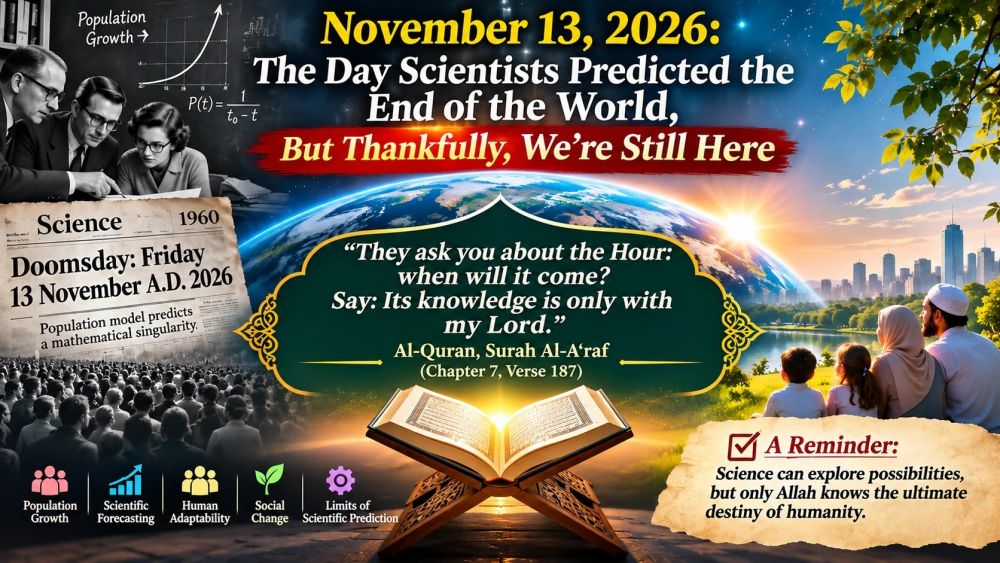
79/2026
Imagine waking up and hearing that today was supposed to be the end of the world. Not because of any disaster, but simply because there were too many people. This might sound like science fiction, but in the early 1960s, three scientists made a mathematical prediction that set a specific end date for humanity: Friday, 13 November 2026.
Today that date has come.
Should we be worried?
The answer is actually no. We're not about to be overrun by people. The story behind this is more interesting than the headline. It's a case study in forecasting, population growth, and how society can shape its own future. A prediction that shocked the scientific world
In 1960, Science published a paper with a very dramatic title: Doomsday: Friday 13th November A.D. 2026. The authors were Heinz von Foerster (an Austrian-American scientist and professor) and his students, Patricia M. Mora and Lawrence W. Amiot. Their main idea was that human population growth followed a strange mathematical pattern. Unlike most populations, which grow straightforwardly and linearly, the human population seems to be growing faster. In simple terms, the researchers believed humanity wasn't just adding more people each year; the growth rate was speeding up.
They used population estimates from the past 2,000 years to build a mathematical model, then projected it forward.
The result was astonishing. Their calculations showed that the human population would reach an unimaginable mathematical ceiling on 13th November 2026. They called this mathematical singularity, meaning the population would become effectively infinite. Of course, an infinite human population isn't possible. Their prediction was meant as a mathematical warning about the dangers of uncontrolled population growth, not as a claim that billions would suddenly appear or disappear in a single day.
Still, it got a lot of attention. The prediction appeared in newspapers, sparked public debate, and entered political discussions.
Why did the prediction initially seem so convincing?
What's remarkable is that their mathematical model did track real population growth for several decades. In the 1960s, 70s, and 80s, the actual population numbers matched the researchers' projections so closely that their warning was hard to ignore. The world was experiencing a population boom. Improvements in medicine, sanitation, nutrition, and public health meant fewer people were dying. More children survived infancy, and people lived longer. The researchers worried that if this trend continued, the planet would eventually run out of food, water, space, and other essentials.
Their warning was striking because they suggested that future generations might not starve from lack of food but instead could die from overcrowding. Their solution was just as interesting. They believed people worldwide needed to work together to reduce birth rates.
When human behavior changed, mathematics changed. In many countries, families began to have fewer children. Education improved, healthcare got better, women gained more access to education and jobs, cities grew, and family planning became common. People began to make new decisions about how many children to have.
As a result, the population grew more slowly over time.
The global birth rate today is less than half of what it was in 1960 (as the historical comparison cited in the ScienceDaily article shows). In other words, the changes the researchers hoped for did happen, but through many social, economic, educational, and demographic shifts instead of one big global effort. Their forecast was based on an observed trend. Once that trend changed, the forecast was no longer valid.
Population growth has slowed, but the problems linked to a large human population remain. Water scarcity, environmental damage, food insecurity, biodiversity loss, climate change, and unequal resource distribution remain major issues. Population growth is still slowing, but that doesn't mean all the related problems are disappearing. Some countries still face rapid population growth, while others deal with aging populations and low birth rates.
Scientific models are useful tools. They help us understand complex systems, find patterns, predict what might happen, and prepare for possible risks. But a model isn't the future. It's just a way to represent reality, based on what we know, certain assumptions, and mathematics.
If people have shown they can alter population trends, can we show the same determination in relation to climate change, environmental damage, resource inequality, and all the other global problems? So, November 13, 2026, wasn't the day the world was supposed to end. Instead, it's a good example of how a scientific prediction can warn us about danger and how our choices can change history.
According to Prof. Emeritus Dr. Muhammad Mukhtar, Rector of the University of Southern Punjab, Multan, Pakistan, divine revelation stands above all forms of human knowledge from an Islamic perspective, including science, mathematics, and scientific predictions. Science is a valuable means of exploring the universe and understanding the laws of nature; however, its scope is limited by human intellect, available evidence, and the ever-changing nature of scientific understanding. The Holy Quran makes it unequivocally clear that the knowledge of the Day of Judgment (قیامت) belongs exclusively to Allah Almighty. In Surah Al-A'raf (7:187), Allah declares that knowledge of the Hour rests only with Him, while Surah Luqman (31:34) reiterates that no human being possesses this knowledge. Thus, no mathematical equation, scientific model, or technological advancement can determine the exact time of Doomsday. The failed prediction of November 13, 2026, reminds us of the limits of human knowledge and the supremacy of divine wisdom. In Islam, science helps humanity understand the creation, but only Allah, the Creator, possesses absolute knowledge of its ultimate destiny.