Runway Went Quiet and the Green Future Took Flight
Posted 3 months ago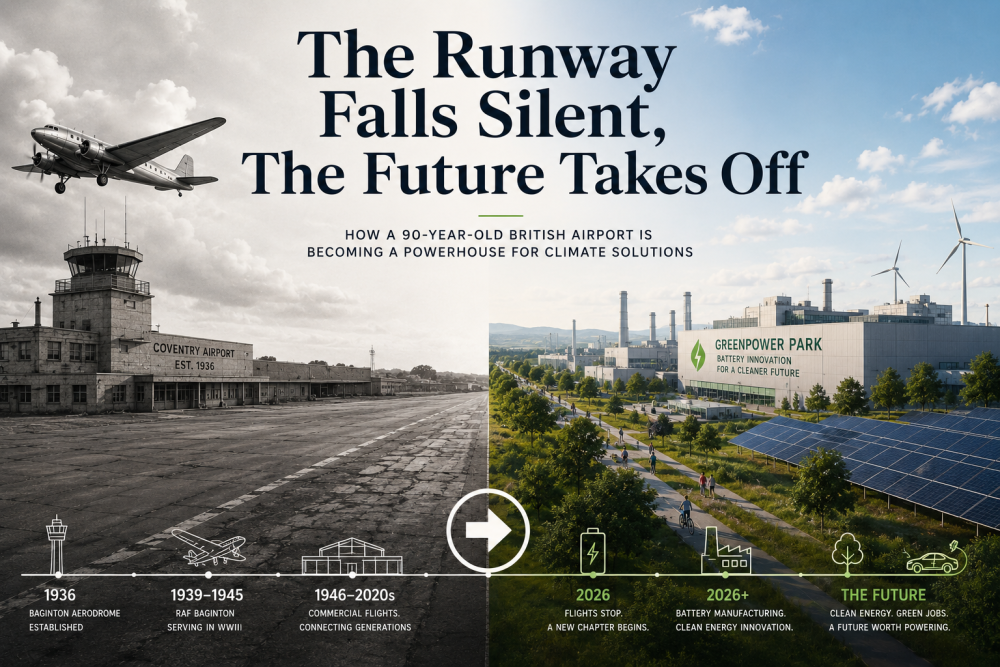
22/2026
In an age when governments still hesitate to confront aviation’s growing carbon footprint, the closure of Coventry Airport may be remembered not as the end of an airport but as the beginning of a new industrial era.
After nearly nine decades of flights, wartime service, package holidays, and commercial aviation, the historic British airport has officially ceased operations, clearing the way for a £2.5 billion GreenPower Park dedicated to electric-vehicle battery production. The redevelopment is expected to create up to 6,000 jobs and reposition the region at the center of Britain’s green manufacturing transition.
For decades, airports symbolized economic ambition. Bigger terminals, more flights, and rising passenger numbers were treated as unquestionable markers of progress. Yet the climate crisis has fundamentally altered that equation. Aviation remains among the fastest-growing contributors to greenhouse gas emissions, while governments across Europe struggle to reconcile net-zero pledges with continued airport expansion.
Rather than preserving underused aviation infrastructure, Britain has chosen to repurpose a relic of the fossil-fuel era into a hub for clean energy technology. The symbolism is hard to ignore, where aircraft once burned jet fuel, factories may now help power the electric transition.
Coventry’s runway may now fall silent, but its reinvention speaks loudly.
At a moment when much of the world remains paralyzed between climate promises and action, this former airport in the English Midlands has delivered something rare: a visible, irreversible shift from carbon-intensive mobility to a cleaner industrial future.
Sometimes progress does not arrive with another departure board; instead, it begins when the flights stop.