Understanding Carbon Footprint - Lecture 7A -
Posted 9 months ago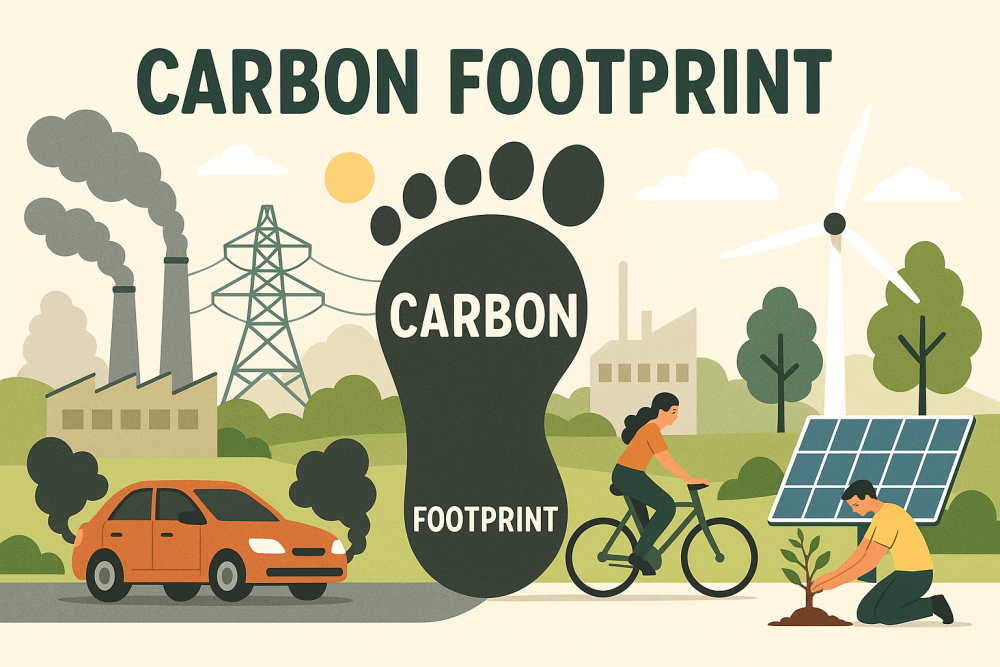
76/25
📌 1. What Is a Carbon Footprint?
A carbon footprint measures the amount of greenhouse gas (GHG) produced by a person, product, company, event, or country. It includes gases like carbon dioxide (CO₂) and methane (CH₄) that trap heat in the atmosphere and contribute to climate change. These emissions result from our daily activities — from driving cars to cooking food and producing electricity.
👉 Think of a carbon footprint like the environmental “footprint” we leave behind — the bigger the footprint, the more impact we have on the climate.
🌡️ 2. Why Does Carbon Footprint Matter?
Carbon footprints help us understand how human activities impact the Earth’s climate. When large amounts of greenhouse gases are released into the atmosphere, they intensify the greenhouse effect, which warms the planet and results in rising temperatures, changing weather patterns, melting ice caps, and more severe climate events.
👉 By measuring carbon footprints:
- We can identify what activities create the most emissions.
- We can find ways to reduce those emissions.
- individuals, communities, companies, and governments can make better decisions for a sustainable future.
🔍 3. What Contributes to Your Carbon Footprint?
Carbon footprints come from both direct and indirect sources:
Direct Sources
- Driving a petrol or diesel vehicle.
- Heating your home with fossil fuels.
- Using electricity made from coal or gas.
Indirect Sources
- The energy used to make your food or clothes.
- Emissions from manufacturing products you buy.
- Fossil fuels are burned to power factories and produce electricity.
👉 All these emissions add up and become your total carbon footprint.
🧠 4. How Do We Measure It?
Carbon footprints are typically measured in tons of CO₂ equivalent (CO₂e), a standard unit that allows us to compare different gases based on how much heat they trap in the atmosphere.
For example:
- A long flight adds many tons of CO₂e.
- A meat-heavy diet generally has a larger carbon footprint than a plant-based diet.
This kind of measurement helps researchers, governments, and companies track emissions and design strategies to reduce their impact on climate change.
🔄 5. Why Should We Try to Reduce Carbon Footprints?
Reducing carbon footprints helps to:
✔ Slow global warming and climate change
✔ Improve air quality and public health
✔ Protect ecosystems and biodiversity
✔ Build more sustainable communities
Every small action — like using public transport, saving energy at home, planting trees, or choosing greener products — can help shrink our carbon footprint.
✅ Quick Summary
|
Topic |
Simple Explanation |
|
Carbon Footprint |
Total greenhouse gas emissions from activities. |
|
Why It Matters |
Helps measure human impact on the climate. |
|
Sources |
Direct (driving, heating) + Indirect (production, electricity). |
|
Measurement Unit |
Tons of CO₂ equivalent (CO₂e). |
|
Goal |
Reduce footprints to protect the planet. |
📝 Self-Assessment Questions & Answers
Q1: What is a carbon footprint?
A: It is the total amount of greenhouse gases, especially carbon dioxide and methane, released directly or indirectly by an individual, product, organization, or activity.
Q2: Why is a carbon footprint important in environmental science?
A: It helps us understand how human activities contribute to climate change and provides a basis for reducing emissions to protect ecosystems and future generations.
Q3: Give two examples of activities that increase a person’s carbon footprint.
A:
- Driving a car that burns petrol or diesel.
- Eating foods that require a lot of energy to produce, like red meat.
Q4: What is the unit commonly used to measure carbon footprint?
A: It is measured in tons of CO₂ equivalent (CO₂e), which standardizes the effect of all greenhouse gases on climate warming.
Q5: How can individuals reduce their carbon footprints?
A: By using energy-efficient appliances, reducing waste, choosing public transport, eating a sustainable diet, and supporting clean energy solutions.
📘 Multiple Choice Questions: Carbon Footprint
Q1. What does the term “carbon footprint” mainly describe?
A. The size of forests in a country
B. The amount of carbon stored in soil
C. The total greenhouse gases released by human activities
D. The natural carbon cycle only
✅ Correct Answer: C
Q2. Which gas contributes the most to a carbon footprint?
A. Oxygen
B. Nitrogen
C. Carbon dioxide
D. Helium
✅ Correct Answer: C
Q3. Which of the following activities produces the highest carbon footprint?
A. Riding a bicycle
B. Using solar energy
C. Driving a petrol or diesel car
D. Planting trees
✅ Correct Answer: C
Q4. Carbon footprints are commonly measured in what unit?
A. Kilograms of oxygen
B. Tons of CO₂ equivalent (CO₂e)
C. Calories per day
D. Liters of fuel
✅ Correct Answer: B
Q5. Which of the following is an indirect source of carbon footprint?
A. Exhaust from a car
B. Smoke from a factory chimney
C. Electricity used at home generated from coal
D. Breathing by humans
✅ Correct Answer: C
Q6. Which lifestyle choice helps reduce an individual’s carbon footprint the most?
A. Using plastic bags
B. Leaving lights on unnecessarily
C. Using public transport or cycling
D. Eating more processed food
✅ Correct Answer: C
Q7. Why is reducing carbon footprint important?
A. To increase industrial production
B. To slow down climate change
C. To increase fossil fuel use
D. To reduce population growth
✅ Correct Answer: B
Q8. Which sector contributes significantly to global carbon emissions?
A. Education
B. Transportation
C. Libraries
D. Sports
✅ Correct Answer: B
Q9. Which of the following foods generally has a higher carbon footprint?
A. Vegetables
B. Fruits
C. Red meat
D. Grains
✅ Correct Answer: C
Q10. Planting trees helps reduce carbon footprint because trees:
A. Increase soil erosion
B. Produce carbon dioxide
C. Absorb carbon dioxide from the atmosphere
D. Stop rainfall
✅ Correct Answer: C
Additional Readings:
- https://www.green.earth/carbonfootprints?
- https://carbontrail.net/glossary/carbon-footprint/?
- https://css.umich.edu/publications/factsheets/sustainability-indicators/carbon-footprint-factsheet?